M
M
Business as usual
I work with individuals and groups from business, education, culture, entertainment and the public sector. I work with individuals and groups from business, education, culture, entertainment and the public sector.
Professional skills you can lean on
A strength you can lean on under pressure
The backbone of advanced English is a bigger vocabulary. Project confidence and reassure those around you. pronunciation, formality and word choice. sound more native. bigger vocabulary
It is not the strongest of the species that survives, nor the most intelligent, but the one most responsive to change.
Charles DarwinLearning is faster when it's personalised and feels like it's part of your work
How we learn is changing: The human touch
Every year, studies show that Sweden has one of the highest standards of English in the world. Yet I meet experienced professionals who hesitate when using English.
There's so much potential. Yet I meet business leaders and experienced professionals who hesitate. Yet I meet business leaders and experienced professionals who hesitate.
That’s when English starts to feel more like second nature than a second language. It becomes a strength you can lean on.
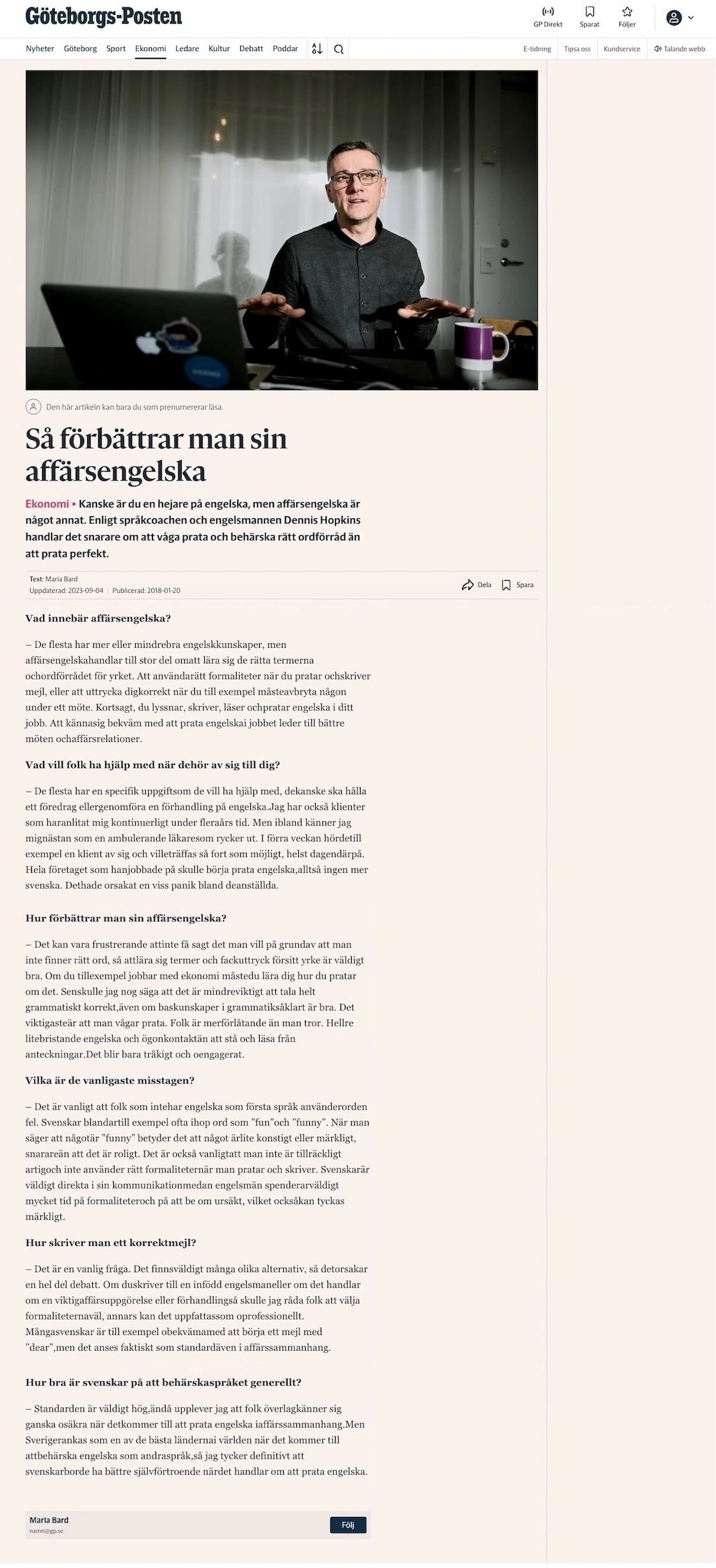
You can learn more about my work with professionals in Sweden in my interview with Göteborgs-Posten.
There’s no typical role or industry. I work with executives, lawyers, engineers, project managers, politicians and other specialists from the public and private sectors. They’re professionals who set a high standard for their work, or those who simply want a little more polish and confidence. Adapting to individual needs and professions is something I really enjoy.
You need a working level of English. By that, I mean you can hold a conversation and manage your work, but you probably feel you’re missing words and struggle to express yourself clearly. Using the CEFR standard, this is around a B1 level and common for many in Sweden.
We’ll talk through your goals and I'll prepare a learning plan. A conversation will give me a better idea of your English level, and you’ll get a feeling for what I’m like as a person. The best progress needs consistency, so we’ll also talk about session frequency and times that fit your schedule.
These terms might sound confusing, so some clarification can be helpful. Think of English teaching as being about knowledge and rules, whereas coaching is personalised guidance that shows how they're applied in real situations.
Yes. Groups are a great way for colleagues to learn together. To ensure that everyone participates fully, I strongly recommend limiting group sizes to around 5–7 participants. I assess everyone's English to structure groups, so they're all at a similar level and benefit equally.
Where possible, I try to accommodate some clients that need coaching outside of office hours or have a deadline with a short timescale. More information about questions related to times can be found in the terms and conditions.
Learning is personal and involves some trust, so it's natural you might feel some uncertainty. A first conversation will make this clearer. You should always feel comfortable, but there’s no pressure to continue after the first session if you're still unsure.
I offer corporate and individual rates. I often work with clients who are self-funded.... Academic hour?
Yes. How this is structured very much depends on your goals. Sometimes these are a clear and sometimes need time.
Absolutely. I can help you prepare for an English qualification from one of the recognised providers such as Cambridge English. I've helped professionals... work abroad or develop their career.